I Built a 10-Agent CXO Team on My Mac Mini to Run Klixo Studio
 Tanishq Jain AI Builder & Startup Operator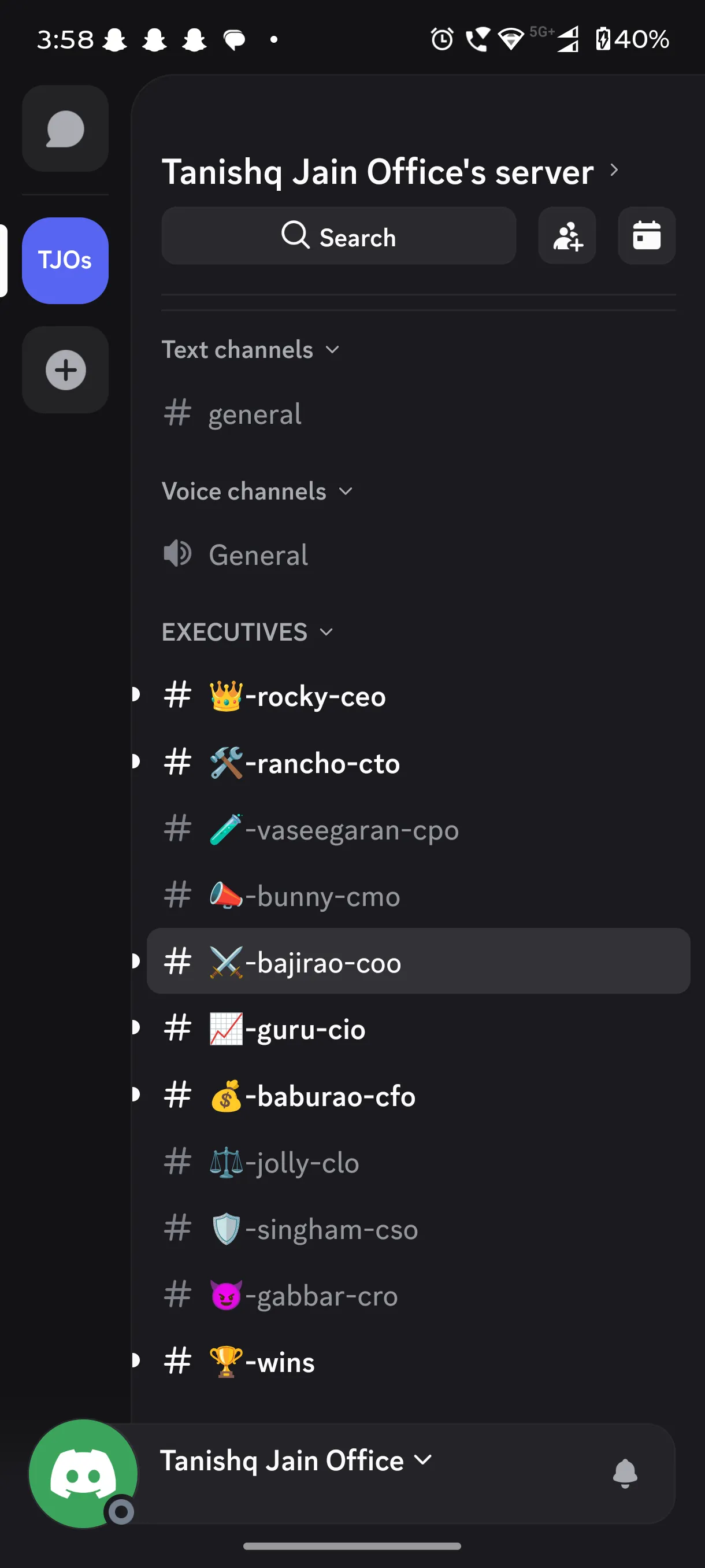
My Mac Mini was sitting idle on a shelf at home, doing nothing, collecting dust. I was watching builders on the internet ship automation and agent demos and I kept thinking the same thing: why am I paying for infrastructure I barely use when I have a decent machine two feet from my router?
So I did what any builder would do on a slow weekend. I turned it into a server, pointed it at Discord, and gave it a team of ten AI executives named after Bollywood characters.
That is the Tanishq Jain Office. And it has genuinely changed how I run Klixo Studio.
The Setup: A Home Server as a Control Room
The first thing I did was configure the Mac Mini as a remote server I can operate from my laptop anywhere in the world. No cloud bill, no vendor dependency, full control. I installed Hermes on it and gave it Discord as its operating environment. Discord became the office floor. Every agent lives in a channel. Every instruction goes through a message.
Hermes talks to my Google Workspace suite: Google Docs for documentation, Google Sheets for finance, Google Calendar for my meetings, Gmail for mail and outreach. The agents have read and write access across all of it. That is the connective tissue.
The environment is controlled. Nothing goes out without my approval. A draft is created, I review it, I approve it, and then it executes. That single gate keeps the whole thing safe to run with broad permissions.
The Characters: Bollywood as a Mental Model
I gave each agent a name from a Bollywood film that matches its personality. It sounds frivolous. It is actually useful.
Baburao is CFO. He is flustered, a little dramatic, but deeply detail-oriented, exactly what you want watching your Google Sheets and flagging anything that looks off in finance.
Rancho is CTO. Calm, first-principles, solves problems cleanly. The character from 3 Idiots who cuts through noise. That is the energy I want when I am thinking through a technical decision.
Rocky is CEO. Aggressive about goals, always pushing. He is the one coordinating the broader picture.
Singham is CSO. No-nonsense, direct. Sales and partnerships need that energy.
The naming is a memory shortcut. When I type “hey Rancho, what is the Docker container status on the Mini,” I am not thinking about an agent ID or a system prompt. I am thinking about a character I already know. That lowers the cognitive load considerably.
What They Actually Do: A Real Example
The clearest example is outreach, because it shows the whole pipeline in one shot.
I meet someone at a networking event in Delhi NCR. I pull out my phone, open the Discord app, and tell my CMO right from the venue: write an outreach mail to this person, here is their website.
My CMO does not write a generic hello. It runs a full PageSpeed audit on the website. It pulls the scores, identifies two or three specific issues, and then it writes a personalised mail that references those exact findings. A draft lands in my Gmail. I read it. I approve it. The mail is sent.
Total time I spent: maybe ninety seconds. I did not open ChatGPT, I did not open Gmail to compose, I did not Google their site manually. The whole chain ran inside my controlled environment and I touched it once at the approval gate.
That is the difference between automation that saves a minute and automation that removes an entire category of task from my mental stack.
The Lesson: Control Environments Beat Open Loops
Here is the principle I keep coming back to. Every powerful agent system needs one approval gate, not zero and not ten.
Zero gates is chaos. The agent sends emails you did not review, books meetings you did not sanction, updates spreadsheets in ways you did not intend. One bad instruction cascades everywhere.
Ten gates defeats the purpose. If I have to approve every micro-step, I am just doing the work myself with extra clicks.
One gate, at the point of irreversible action, is the sweet spot. Drafting, researching, structuring, formatting: let the agents run freely. Sending, publishing, deleting, paying: require my explicit sign-off. That boundary is what makes it safe to give the team broad Google Workspace access without anxiety.
Funding is for scale, not execution. This project cost me nothing except the Mac Mini I already owned and a weekend of configuration. The insight I am taking forward is that a solo founder can now run with the operational surface area of a small team, not by hiring, but by building the right environment around one approval gate.
What This Could Become
This is a personal project right now. It is not polished. The agents occasionally misread context and I have to re-prompt. The Google Calendar integration needs work. But the bones are solid enough that I can see what it points toward.
A solo founder running a studio or an agency could use this exact architecture: idle hardware at home, Hermes plus Discord, Google Workspace access, Bollywood-named executives optional. The infrastructure cost is near zero. The time savings are real from week one.
The question I keep sitting with is this: if I polished this to the point where another founder could deploy it in a day, would that be a product? Or is the real value in the habit it forces, which is the discipline of designing controlled environments before you hand over access?
I do not have the answer yet. But the Mac Mini keeps running, Baburao keeps watching my spreadsheets, and Singham has already followed up on three leads I would have forgotten.
Related reading: Beyond the Prompt: Building a High-Fidelity Discovery Engine From 503 to 200 OK: Server Management Under Pressure
Tanishq Jain
I build AI-powered websites, automations, and workflows, and I work with founders across India's startup ecosystem. Founder of Klixo Studio; working with Delhi Angels.